Showing posts with label Energy Efficient. Show all posts

Sunday, March 14, 2010

Blog Talk Radio - Vapur, Radley London, Anvil Eco, YogaFit, ECOS, Skoy, GlacialLight and Sylvania

Tune in Wednesday March 17th at 8 p.m. Central Time (9 p.m. Eastern, 6 p.m. Pacific) to the 1GreenProduct.com show on Blog Talk Radio for reviews of these eco-friendly products.

(If you're unable to listen to the show live, you can always download it later and listen to it at your convenience.)

Have questions or comments about other products we've reviewed in the past? Call in to the show (347-945-6594) and share your thoughts!


Radley London Umbrellas and Totes made from post-consumer PET plastic bottles and other recycled materials.  ($50 for umbrellas, $35 for totes). Note that only the Nostalgia and Beside the Seaside styles within the Umbrella collection are made using recycled materials.


Sylvania Ultra LED high performance series 8-watt bulb ($29.98 via Lowes.com)


Floodlight-style LED GlacialLight (GL-BR30, $44.95 via C. Crane Company)


YogaFit jacket made from 70% bamboo ($25.99 via YogaFit website) Correct link and image posted on 3/24.


Skoy Cloth 100% biodegradable cleaning cloth ($5.99 for a 4-pack)


Anvil Knitwear Eco (available for direct purchase here) collection including AnvilRecycled T-shirt ($10) made from 69% recycled cotton...


....AnvilSustainable T-shirt ($12) made from recycled PET plastic bottles and transitional cotton (grown on farms that are striving to obtain organic certification)...


....AnvilSustainable fleece sweatshirts ($37) made from a blend of organic cotton and recycled plastic bottles...


...and AnvilOrganic T-shirts ($12) made from 100% certified organic cotton


To hear reviews of all these products, discuss any past reviews on 1GreenProduct.com or talk about whatever eco-friendly products you've got on your mind, remember to tune in Wednesday March 17th at 8 p.m. Central Time (9 p.m. Eastern, 6 p.m. Pacific) to the1GreenProduct.com show on Blog Talk Radio.

Disclaimer - All of the companies mentioned above sent me free samples of their products for testing purposes.

Update - Did you miss the live Blog Talk Radio broadcast? You can still hear the show at your convenience by clicking the button below...

Thursday, January 28, 2010

2010 Honda Insight

2010 Honda Insight (photo via Honda website)

They say, "Variety is the spice of life."

(Personally, I'd choose Garlic as the spice of life, but hey, Variety tastes good too.)

Which is why after more than 200 written reviews of green products, I've decided to branch out a bit and try my first audio review of the 2010 Honda Insight.

To create this audio podcast, I used a service called BlogTalkRadio. As the name suggests, BlogTalkRadio is really intended to be use less as a 1-way podcast and more as a 2-way (or 3-way or more-way) conversation.

But since this was my first time trying BlogTalkRadio, I just went ahead and recorded it as a typical podcast. In the future, I will give advance notice of my BlogTalkRadio shows here on this blog and also on some of my other social media sites (Twitter, LinkedIn, etc.) so that anyone who wants to can call in and participate.

Of course, if you miss the show live you can also listen anytime using the BlogTalkRadio widget.

Listen to 1GreenProduct.com on Blog Talk Radi

What do you think? Do you like the audio approach? Do you have ideas or requests for future shows?

Thanks for reading - and listening! Hope you enjoy my radio review of the 2010 Honda Insight.

Wednesday, January 20, 2010

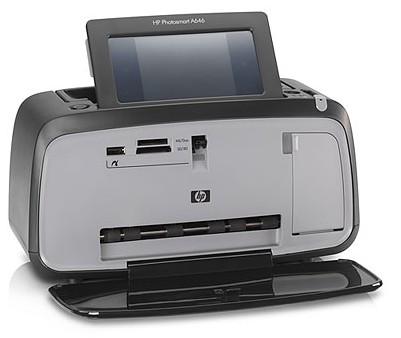
HP Photosmart A646 Compact Printer

HP Photosmart A640 Compact=
HP Photosmart A646 Compact Printer

In the old days of film cameras, you'd go on vacation, come home, dither for a while, then take your film to a developer (or mail it off) and end up with a handsome set of blurry 4x6 prints of family members with the tops of their heads cut off.

The good news is that nowadays with digital cameras we can perfectly compose works of art using the screens on the back of the cameras and store hundreds or even thousands of photos on a single memory card.

But somehow - most of the time - nobody actually has time to sort through all those images and print out the best ones.

I know that we've got years of photos sitting on hard drives and stored on photo-sharing websites, but only a handful of prints.

That's why I was so eager to test the HP Photosmart A646 Compact Printer. As HP says, the printer lets customers view, edit, create and personalize photos using the TouchSmart control panel.

What makes it eco-friendly? First of all, it's small. It's hard to tell from the picture, but the whole package isn't much bigger than a small toaster. Making something small generally means using fewer raw materials.

Second, it's Energy Star-rated as energy efficient.

In addition, nearly 1/3 of the printer's body is made from recycled plastic. You'd never know this just by looking at the printer, as it looks and feels as solid and sleek as any other piece of electronics these days. I continue to be impressed at the way that recycled plastic can look just as good as 'virgin' plastic.

And the printer itself is so small and compact that it can easily be carried from one place to another using the included reusable tote made from recycled plastics. (By shipping the printer within this tote, HP has really managed to cut out a lot of unnecessary packaging waste.)

How did the printer work in action? Initially, I thought the quality was a little below photo lab standards. Looking closely at certain parts of the picture, I could see a linear pattern where the printer had put down ink. As the printer got warmed up, the quality seemed to improve, although I still feel like you'll get somewhat better quality from a lab.

What HP does give you is convenience and ease-of-use. We printed photos both by connecting the printer to a desktop computer with a standard (not-included) printer USB cable, and also by plugging a memory card directly into the printer. Both worked just fine, although the computer option seemed to work better since I had trouble locating specific images on my memory card using the printer's touch-screen display.

We also had some issues where printed photos were cropped a bit differently than they displayed on the computer. The issue seemed to occur a bit randomly and did not necessarily seem to be linked to the size or shape of the image as displayed on the computer screen. To be honest, I didn't delive into the instruction manual to see if there was some way of getting around this cropping problem.

Also note that you'll need to take both paper and ink costs into account when determining if the printer is right for you. We typically managed about 40 photos per cartridge. HP did include a handy, eco-friendly postage-paid envelope (folded nicely into a tiny package) for returning spent ink cartridges for recycling.

What's the final verdict? Between its recycled plastic content, its energy efficiency and its small size, the printer seems like a fairly Green product. I may not be smitten with the print quality, but for procrastinators like myself an HP Photosmart A646 Compact Printer could be just the ticket for getting some of your photos off the screen and into the real world on paper that can be handed around, put in a wallet or in a frame and hung on the wall.

Finally being surrounded by physical, tangible reminders of happy moments from the last few years? That's pretty sweet.

Where to buy:

Buy directly from HP for $149.99 or from Amazon.com for $99.99.

Disclosure - HP loaned me an A646 printer for testing. I sent it back when the test was complete.

Wednesday, January 13, 2010

2010 Toyota Prius V

The 3rd Generation Toyota Prius - Greenest car on the road
The 3rd Generation Toyota Prius - Greenest car on the road (image via Toyota website)


No need for waffling here. The verdict is simple. The Toyota Prius gets top honors for the most eco-friendly car I've driven thus far.

Over 10 days of driving and nearly 2000 miles, the 3rd generation version of this iconic hybrid champ delivered fuel efficiency (mostly on highways with 70 mph speed limits) in the 45 mpg range.

I had a chance to test the 2nd generation Prius back on last summer's Colorado trip and I have to say that this new generation takes a dramatic step forward in comfort and driving performance.

The 2010 car comes with both EV mode and Power mode buttons. Press the EV mode and the car will operate off electric power only provided the battery has enough juice and you're moving slowly enough. Press the Power button and you get a potent boost of acceleration that lets you rocket onto the highway or scoot past other cars in the parking lane. (I'll admit it, I got a thrill from passing both a BMW and a Porsche on the highway in the Prius.)

The top-of-the-line V version of the Prius came loaded with luxurious extras including heated side mirrors, heated front seats, a voice-activated touch screen DVD navigation system, satellite radio, integrated backup camera and so forth. I'll admit that I never figured out how to work out some of the options (like Intelligent Parking Assist).

The Radar Cruise Control is a nifty feature that takes us one step closer to the notion of self-driving cars. Basically, a radar device in the nose of the car can sense if you're getting too close to the car in front of you and try to adjust accordingly. If you're already a fan of cruise control, the Radar version will probably make you even happier, but personally I've found that I usually can get better mileage and feel safer with cruise control off on all but the most empty roadways.

My favorite geeky tool on the Prius V was the Lane Keeper Assist (LKA) device that actually keeps track of the lanes and not only beeps to warn you if you're veering outside the lines, but actually gives you a nudge back toward the center of the lane. (Putting on the turn signal supersedes the LKA so you don't need to worry about fighting the car when it comes time to exit the highway or switch lanes.) I think LKA could literally be a lifesaver on dark roads or in cases where the driver is a little bit tired. I wouldn't say it eliminates the need to pay attention or to get enough rest, but LKA definitely seems like the best active safety device I've seen since inventions like Anti-Lock Brakes and Vehicle Stability Control.

From a design standpoint, the new Prius has better lines on the outside and more comfort on the inside. Focusing on the sharp lines of the exterior, I think the Prius has truly entered the 'beautiful car' category.

Meanwhile on the inside, with the rear seats folded down, the cargo capacity seemed voluminous. I liked the high clearance on the hatchback door. The seats were supportive and reasonably comfortable even after 9+ hours on the road. The view through the rear window is still somewhat obstructed by a horizontal solid panel, but Toyota has definitely improved visibility over the previous generation Prius.

Really, I have only two complaints about the Prius. One is mileage. Yes, the Prius gets great mileage, but for the price (more on this later), I would have liked even better mileage. Call me demanding, but since I somehow managed to achieve 50+ mpg in a 2nd generation Prius, I would have hoped to get at least 50 mpg in the next generation Prius.
The second issue is price. Highway mileage of 45 mpg is great, but these days lots of conventional gasoline-engine cars are knocking on the mid-30s in terms of highway mpg. My wife and I will be doing some car shopping ourselves in the near future, and despite being an eco-conscious shopper, I'm having some trouble justifying the Prius premium.

After all, the 2010 Toyota Corolla is rated at 35 mpg on the highway and I've seen promotions for Corolla leases for around $160/month. By contrast, I haven't seen the Prius offered with any lease specials at all. (I called one dealer and was told that a Prius lease would probably cost me $300-500/month.) For folks who prefer leasing, this makes the Prius relatively unattainable. (From a straight purchase standpoint, you'll pay around a $7,000 premium for a Prius over a Corolla.)

So ultimately, the Prius is a fun car and a fantastic choice for any eco-friendly driver. But I keep hoping that Toyota will push the envelope more in terms of both mpg and affordability. Perhaps we'll see some new developments next year in terms of a hybrid Yaris that will check both those boxes?

Perpetually unsatisfied. I suppose so. But that's what makes me excited about all the eco-friendly advancements I think we'll see this year and beyond. We've made great strides in terms of Green gadgets and tools, but there is still a long way to go to get to the point where we can enjoy comfortable high-tech lives without placing too much of a burden on the planet.

PS - Interested observers have inquired as to the relative environmental costs of producing a Prius compared to a typical gasoline-only (i.e. non-hybrid automobile). I asked Toyota about this and received a response from Wade Hoyt, Northeast PR manager that " the Prius's manufacturing carbon footprint is slightly higher [than the footprint of a non-hybrid mid-size sedan]. However, when looking at its total lifecycle assessment, including manufacturing, plus the in-use life of the car, as well as its end-of-life recyclability, Prius's carbon footprint is significantly smaller." I tried to get some hard data to quantify the Prius's carbon footprint advantage, but was told that such data has not been released outside the company.

Where to Buy:

At your local Toyota dealer, of course! The 2010 Prius starts at $22,400, but prices can climb steeply from there. With delivery and processing fees added in, my tester car had a total MSRP of $32,771. Ouch.

Disclosure: Toyota generously allowed me to test drive the Prius for more than a week.

Wednesday, November 25, 2009

Electrolux UltraSilencer Green


Electrolux UltraSilencer Green canister vacuum cleaner
In August 2008, I reviewed an energy-efficient Eureka vacuum cleaner called the envirovac.

At the time, I gave the envirovac a thumbs up for performance, design and value. The bagless washable canister and filter meant that the vacuum wouldn't have any obvious recurring costs beyond its ultra-reasonable $72.22 price (via Wal-Mart).

But not everyone likes an upright vacuum. You can be an upstanding citizen (or even a member of the Upright Citizens Brigade) and still prefer a canister vacuum for example. (Here's a webpage by one canister-lover.)

So I was happy to have the chance to test the new Electrolux UltraSilencer Green canister vacuum that debuted in the US just a couple of months ago.

Although it sounds like some sort of weapon that 007 would use to dispatch his enemies in secret, the UltraSilencer Green is actually just a really quiet vacuum (maximum 71 decibels). If other vacuums sound like garbage trucks, the UltraSilencer Green is like a well-tuned Mazda Miata.

Electrolux UltraSilencer Green canister vacuum cleaner
The UltraSilencer is not only compact and nicely designed, it's also lightweight and easy to transport around the house. The Electrolux website says the vac tips the scales at approximately 12 lbs. For comparison, Wal-Mart lists the shipping weight of the envirovac as nearly 20 lbs., though the comparison is obviously not apples-to-apples since packaging can certainly add to the shipping weight.

And while Eureka had packaged the envirovac in a recycled box, Electrolux goes one step further by reportedly using 55% recycled materials in the construction of the UltraSilencer Green, while making the vacuum itself 90% recyclable. I love the cradle-to-cradle design philosophy at work here, and Electrolux says that using the recycled materials in building the UltraSilencer Green saves 2 liters of crude oil and 80 liters of water per vacuum cleaner. ((Note that there are various UltraSilencers made by Electrolux. I presume that only the Green one has the recycled/recyclable characteristics.)

From a performance standpoint, I have to admit that I probably like the feel of upright vacuums a bit better, but I did appreciate the light weight and flexibility of the UltraSilencer Green's long hose. With enough use, I'd probably get used to manuevering the UltraSilencer Green around the apartment. Suction was certainly more than adequate enough to pick up small debris from hardwood floors and low-pile carpet. (In fact, the suction was strong enough to lift entire unsecured carpet tiles right into the air!)

Electrolux UltraSilencer Green canister vacuum cleaner
I only really have one major gripe about the UltraSilencer Green. Although the Electrolux UltraSilencer Green is advertised as being 1/3 greener than comparable vacuums (presumably canister vacs), its 1250-watt maximum power usage is still significantly higher than the 960-watt needs of the 2008 envirovac. Since I like to that that efficiency marches hand in hand with progress into the future, it would have been nice if the UltraSilencer Green had used fewer than 960 watts, but perhaps canister vacs just have higher power needs (and better suction?) than upright vacs...


Where to buy:

You can buy the Electrolux UltraSilencer Green online through Bed Bath & Beyond for $299.

Disclosure - Electrolux lent me an UltraSilencer Green vacuum to review.

Wednesday, November 4, 2009

Smart fortwo Passion Cabriolet

smart fortwo cabriolet

Lowering the top on the smart fortwo cabriolet is a breeze


Parking a smart fortwo should be at the top of the list of Easiest Things in the World.

Even if the parking space is lilliputian, even if you have approached it from an odd angle, even if the cars on either side of you are gargantuan trucks, you should be able to squeeze into the space with room to spare.

I must confess that I was a little nervous to test driving the smart fortwo. Yes, I requested a loan of the car. After years of decrying the practice of individual people commuting in massive trucks, I decided it was time to squeeze myself into what is surely the tiniest car on the market today.

The two-passenger smart car's dimensions tell the story. Its total length is less than 9 feet - more than 3 feet shorter than the already compact Mini Cooper. The relative tinyness of the smart fortwo has an interesting effect on interactions with other drivers. You must drive defensively because some drivers will act as if they simply don't see you because it's impossible anything as small as a smart fortwo is actually on the road. On the other hand, there are also drivers who are also so charmed by the smart fortwo's cuteness that they will wave you along and give you some special deference, much as a tiger might refrain from chasing a canary.

Does the smart fortwo feel cramped inside? Not particularly. I stand over 6-feet tall and I had plenty of headroom, enough elbow room and just enough leg room.

Of course, you can't take long road trips in the smart fortwo - unless you put your luggage into a compacting machine first. If you want to see out the (small) rear window, don't count on holding more than your smallest suitcase and a couple of bags of groceries. That's all we managed to fit in the Smart's 7.8 cubic feet of cargo space (up to the belt line).

The smart fortwo coupe. Cute? You betcha.
How about the smart fortwo's design? Cute as a button - and about the same size! :) People will stare. They may start conversations or ask to trade the smart fortwo for whatever gas-guzzler they're driving. Almost every time I parked the smart fortwo, I turned to marvel at how compact and fun it looked next to whatever staid minivan or sedan was parked next to it.

I thought the fit and finish of the inside components was generally pretty good. I liked the bold red accents on the dashboard and control panels.

I was also very impressed with the performance of the Cabriolet roof that opened and closed at the push of a button by sliding along a track at the top of the vehicle.

On the other hand, I would have exchanged the Passion Cabriolet's complicated audio system in a heartbeat for an interval windshield wiper system or cruise control.

So from a looks, design and fit standpoint, I was pretty pleased with the smart fortwo. Then I started driving it.

I had been a little trepidatious based on my advance read of several blogs including Edmunds and The Truth About Cars that excoriated the smart fortwo's transmission, acceleration and handling.

Basically, I wholeheartedly endorse their conclusions. I drove the Smart in urban traffic (Brooklyn, Manhattan), suburban (Long Island) and rural (Hudson Valley). If your commute involves very smooth, straight roads at moderate speeds of 40-50 mph, the smart fortwo could be a good car for you. But if your route involves winding roads, hills, highways where good acceleration is a must or the traffic flows around 70 mph, I would say that the smart fortwo could very well make for a scary ride.

I'm not refering to its size or safety characteristics. Smart has created a great website (SafeandSmart.com) with compelling personal anecdotes about the strength of the car's "safety cell" structure. I fully sort of believe that the safety cage would protect me in a crash, but I'd prefer to avoid getting in a crash in the first place and I had several occasions (off ramps, on ramps, hard turns, occasions that called for acceleration) where I felt that I was lucky to avoid collisions with other vehicles or the landscape in my smart fortwo.

And then there's the small matter of bumps in the road. Both my passenger and I actually had back pain after driving for several hours in the smart fortwo down admittedly very potholed and uneven highways in the NYC metro area. Yes, I blame the highways, but I've ridden electric bicycles that offered a smoother ride at 20 mph on New York's streets.

I could go on to talk about how the 'automated manual transmission' drove me crazy in both full automatic and semi-manual modes. Or about how the vibration and engine noise are exhausting even at low speeds, but you probably get the picture.

It's all a shame since the smart fortwo really is an attractive car from an eco-friendly standpoint. In mostly highway driving, I managed to get around 40 mpg, which is very impressive for a non-hybrid car.

Not only that, but the smart production process is pretty eco-friendly too, including the use of prefabricated modules at the French factory where smarts are produced, plus water-soluble paints, recyclable body panels and a power-coating of the safety cell that eliminates the need for solvents.

Heck, the car even has 'flax-based components' in its dashboard! How cool is that!

The car itself is classified as an Ultra-Low Emission Vehicle (ULEV). Smart's press materials trumpet the clever design of an electric pump that "blows fresh air into the exhaust port when the engine is cold to almost completely oxidize the carbon monoxide (CO) and hydrocarbons (HC) and render them harmless." Sounds good to me.

Truth be told, I would have a hard time recommending the current generation of the smart fortwo. As this blog attests, I'm pretty passionate about protecting the environment, but I also have minimum comfort and handling thresholds when it comes to assessing a car and smart fortwo didn't meet them.

On the other hand, I'm still excited about the news that smart is planning an electric version of the fortwo, expected to arrive in the US (via pilot programs) in late 2010. With any luck, the electric car will have better and smoother acceleration. If so - and if smart can improve handling and shock absorption - the electric smart car could be a very smart choice indeed.

Where to buy -

Purchase a smart fortwo at a Dealer near you.

The smart fortwo Passion Cabriolet starts at $16,990, but a few options (like power steering) and destination charge brought the model I tested up to just $17,980.

According to the smart website, there is a base Pure Coupe that lists for under $12,000, but expect to pay extra for options such as air conditioning and radio.

Disclosure - Smart USA lent me a smart fortwo Passion Cabriolet to review.

Friday, October 16, 2009

E+ Electric Bikes - Elite Mountain Bike

In addition to consumer e-bikes, Electric Motion Systems also makes a Tactical Bike for police departments (photo via Electric Motion Systems website)

The powerful, rugged E+ Elite Mountain Bike (photo via Electric Motion Systems website)

Like a little raw speed with your electric bike?

I clocked my tester E+ Elite Mountain Bike from Electric Motion Systems at around 25 miles per hour on a flat straightaway with no pedaling.

The Elite version of the E+ bikes (designed for 'off road use only') comes with a 1000 watt in-wheel motor, but you can get 750 watt motor versions of the E+ bike in Cruiser or Mountain Bike styles that don't have the 'off-road only' stipulation.

The power of the in-wheel NiMH battery and motor system is definitely one of the major selling points for an E+ bike. Mounting the battery and motor low on the bike is also supposed to help keep the bike stable by creating a low center of gravity. The logic is flawless, but in practice it didn't make the bike feel appreciably more stable than any other e-bike that I've ridden.

So here's what I liked about the E+ Elite bike that I tested -

The in-wheel battery and motor design gives E+ bikes a distinctive silhouette (photo via Electric Motion Systems website)

1. Speed and Power - Press down on the throttle lever and the bike takes off. It's like a stealth moped.

2. Rugged design - The bike felt fully capable of handling some light off-road action. The bike's manual indicates that the E+ Elite Mountain Bike can handle paved roads, gravel surfaces and even rough trails with small obstacles, but it does emphasize that the bike should not be used in a jumping scenario. Although it would have been nice if the E+ Mountain Bike came with some splash/mud guards - especially since the bike is designed to allow light off-road use where there's usually a lot of dirt, mud, gravel and other earthy stuff.

3. Made in the U.S.A. - Electric Motion Systems is based in Virginia, and that's where it makes its E+ bikes. I like the idea of supporting domestic production, both in the interests of reducing environmental shipping costs and supporting American workers (particularly in a recession).

4. Style - The E+ Elite Mountain Bike got admiring looks and comments from bike messengers, European tourists and others. It's not flashy, but it will get noticed.

5. Cruise Control - I don't think I've seen this feature on any other e-bike. Press a button on the E+QUE Display/Controller unit on the handlebar and the bike will attempt to maintain a set speed. It's pretty nifty.

6. Regenerative Mode - Like the OHM bike, the E+ bikes can be set into regenerative mode to recharge the battery while going down a hill (or perhaps when the bike is mounted into a stationary rack). Unfortunately, it seemed harder to use the E+ regenerative system than the OHM system. Even on a downhill slope, I had a hard time pedaling the E+ bike in regenerative mode.

Now here are the things that irked me about the E+ Elite Mountain Bike:

1. Price - Even though I didn't pay to test the bike thanks to the generosity of Electric Motion Systems and Scott Gibson of EcoPioneer, I can't test a product without considering its price (and therefore its value). After all, Tesla Motors may make a beautiful electric sports car, but the price puts it out of reach for most consumers.

The E+ Elite Mountain Bike carries a MSRP of approximately $4,000. For perspective, consider that a new Vespa LX50 scooter for MSRP $3,299. True, the Vespa uses gasoline and is therefore less eco friendly, but it does get 95-100 mpg and goes 39 mph (according to the Vespa site).

I'm just saying that I think it will be hard for most people who aren't rolling in dough to spend $4,000 on an electric bike when they could get a gas scooter for hundreds of dollars less (actually thousands of dollars less if they are willing to get a Yamah C3 or Honda Ruckus scooter).

Now Electric Motion Systems is running a limited time offer to give customers a free Elite upgrade plus a rebate. These deals bring the price of the bike down to a more palatable $3,095 with free shipping.

That's better, but it's still a lot of dough and a few hundred dollars more than some other e-bikes we tested like the OHM Urban XU500 or the A2B Electric Two Wheeler (both of which retail for around $2800).

Push-Lever Throttle - The E+ Elite Mountain Bike uses a push-lever thumb throttle on the right handlebar. When you want the motor to kick in, you have to push down on the throttle. It sounds simple enough, but in practice I much preferred the twist throttle used on the A2B bike. As one of my commenters pointed out on the A2B review, it's actually quite safe to have a throttle that needs to be twisted toward you in order to generate power because it makes it much harder to accidentally gun the motor when reaching for the brake. But with a push-lever thumb throttle, I did just that and nearly accelerated into trouble a couple of times when I was trying to execute a sudden braking maneuver.

Weight - Like the A2B, the E+ Elite Mountain Bike tipped the scales around 70 lbs. Since mountain bikes already have more resistance than road bikes due to their thick tires, I found it nearly impossible to pedal the E+ Elite Mountain Bike without constantly using at least a little bit of battery power. I would urge Electric Motion Systems to prioritize weight reduction in their R&D effort, since a 10 or 20 pound lighter bike (like the OHM XU500 or the iZip Via Rapido) is much easier to pedal with pure human power - extending the range and providing the possibility of some exercise. (The combination of mountain bike seating and the need to constantly push the throttle with my thumb ended up putting a lot of pressure on the outside fingers of my right hand. In fact, after one long ride, my little finger and ring finger on the right hand were partially numb and tingly for hours. Not a good feeling.)


Maybe you would prefer your E+ electric bike in a Beach Cruiser style? (photo via Electric Motion Systems website)

Range - Electric Motion Systems says that the E+ Elite Mountain Bike should be able to go 25-28 miles on a full battery at 15 mph with a 185 lb. rider on flat ground and no pedaling. I weigh a good 25 lbs less than that theoretical rider and managed only around 15 miles of range with occasional pedaling on mostly flat terrain. For some of this time, I was experimenting with the Cruise Control feature of the bike (which I later found out might reduce range according to some online forums), but I still have to say that I was disappointed that the battery didn't last a longer distance.

Recharging Process - Not only did the recharging process take many hours, but the process of connecting the charger to the bike itself is a bit cumbersome. (In fact, I ever cut my hand a little bit trying to disconnect some wires in order to get access to the charging plug the first time I tried to recharge the bike. After that, I wore gloves when taking the charger on and off the bike.

Also, because the battery is built into the wheel, it's impossible to take the battery off the bike for recharging without removing the whole front wheel. In my opinion, that's a significant drawback to the E+ design. One of the nice things about the designs of many e-bikes - even much less expensive bikes like the iZip Via Rapido - is that it's easy to park the bike at a rack and remove the battery to take it into an apartment or office for charging. To be fair, taking the wheel off the E+ Elite Mountain Bike isn't that hard, but it is a heavier, more time-consuming, dirtier process than just sliding a battery pack out of the bike and literally putting it into a shoulder bag or bookbag.

Bottom Line - If you have deep pockets and are looking for a fast, rugged, made-in-the USA electric bike that can deliver some serious off-road fun, the E+ Elite Mountain Bike could be just the ticket. For urban commuters, I think there are some less expensive and more versatile options like the A2B (for twist-throttle fans) or the iZip Via Rapido (for those who prefer pedal-assist).

Where to Buy:

The Ellsworth Commute Ride, just one of the sweet custom designs offered by E+ (photo via Electric Motion Systems website)

You can order an E+ Elite Mountain Bike - or any of the other electric bikes that Electric Motion Systems makes - directly through the company's website.

Be sure to check out the sweet array of custom designed e-bikes that E+ can build on request.

Since every e-bike feels different, I'd highly encourage you to test ride an E+ bike at a local dealer in the U.S. or Canada before making a purchase decision.

Be sure to ride safely, wear a helmet and check the local regulations covering the use of e-bikes in your community.

Disclosure - E+ loaned me an Elite Mountain Bike to test and review for approximately one week. I returned the bike to an E+ representative at the end of the test period.

Friday, October 2, 2009

Toyota Camry Hybrid

2010 Camry Hybrid (photo via Toyota.com)
2010 Camry Hybrid - stylish but subtle hybrid (photo via Toyota.com)

In the last few months, I've had a chance to test drive both a Toyota Camry Hybrid and a 2nd generation Prius.

I liked both cars, but from an eco-friendly standpoint it seems to me that the Prius is the clear winner. In Colorado, I averaged approximately 50 mpg in mountainous terrain on the 2nd gen Prius. By contrast, in admittedly horrible traffic in and around the New York metro area, I averaged only around 30 mpg in a 2009 Toyota Camry Hybrid.

Now I presume that the 3rd generation Prius (i.e. the 2010 model year currently for sale in dealerships and advertised on Toyota's website) gets even better mileage and delivers even better performance than the Prius I tested, but I'll restrict my comparison to the older Prius that I actually test drove.

So how does the Camry Hybrid match up against a (last generation) Prius?

For me, the Prius wins by a knockout, offering better manueverability, better forward visibility and much better electric-only performance at low speeds. Indeed, one of the selling points of many hybrid cars is that they are supposed to be able to use electric power only to save gas and propel the car at low speeds. The Prius lived up to this billing, but while the Camry shut down its gas engine at stop lights to conserve gas, it seemed impossible to drive the Camry at more than about 5 mph without having the gas engine kick back in.

In terms of performance, neither car will win any drag races. Both perform admirably when cruising at high speeds, but you'll need to leave plenty of time for accelerating, merging and passing.

So why would a buyer putting eco-friendliness high on her list of purchase criteria choose the Camry Hybrid over the Prius? I can think of only a couple of reasons:

1. Anonymity. Prius drivers advertise their eco-minded attitudes to the world. Remove a couple of subtle little badges and the Camry Hybrid looks just like any of the other countless Camrys on the road. Some people like standing out. Others perfer to fly under the radar - the Camry Hybrid accommodates that desire.

2. Sedan v. Hatchback. I quite like hatchbacks both for their style and their versatility, but some people just want to drive a sedan. Since the Prius is only available as a hatchback, that pretty much disqualifies it from contention. I will say however that the Camry's battery pack reduces its trunk space considerably (a point emphasized in this review at eHow.com). One big suitcase will completely fill the trunk space. Fortunately, the Camry Hybrid comes with standard 60/40 split fold-down rear seats, providing some much-needed extra cargo space (as long as you aren't carrying any passengers in the back seat).

The comfortable, predictable interior of the Toyota Camry Hybrid (photo via Toyota.com)

3. Comfort. Both cars are comfortable from a driving standpoint. In fact, I think I found the Prius even more comfortable than the Camry Hybrid, but the Camry definitely has a bit of a more plush feeling, more of an intangible cushiness factor. For example, dual-zone climate control comes standard and you can upgrade to an options package with heated front seats.

4. Size. The Camry Hybrid is slightly bigger than the Prius. Both are mid-size cars, but the Camry is a few inches wider and more than one foot longer. The Camry Hybrid also weighs about 600 lbs. more than the Prius. For people who equate size with safety and weight, the Camry Hybrid may feel like the safer choice. Also, because of its bigger exterior dimensions, it has a few more inches of interior space, which may make it more comfortable for some people. (These perceptions may have some basis in reality. The National Highway Traffic Safety Administration gives the Camry Hybrid its highest 5-star rating for frontal crashes, whereas the 2009 Prius received only 4 stars. The 2010 Prius had not yet been rated at the time of this review.)

Bottom Line - It's great to see lots of hybrid cars coming to the market for buyers of all tastes. The Camry Hybrid could be the perfect car for someone who wants a solid, comfortable mid-size sedan with good gas mileage (rated 33 city / 34 highway) at a decent price.

IMHO, the Prius is clearly the more eco-friendly car and also a much better value. The Camry Hybrid carries a MSRP of over $26,000 (my tester was $28,138 nicely equipped and including delivery processing and handling fee). For comparison, the base version 2010 Prius carries a MSRP of $22,000 -- although the top-line version does go up over $27,000.

Incidentally, although the Camry Hybrid is clearly the more eco-friendly choice, it's probably very hard to justify the Hybrid version of the Camry on an economic basis. The non-hybrid base Camry (MSRP $19,395) has a nearly identical highway mpg rating (33 mpg vs 34 mpg for the hybrid) and gets 11 fewer mpg in city driving (22 mpg vs 33 mpg for the hybrid).

To the casual observer, it's just a stylish sedan. But we know this 2010 Toyota Camry is a hybrid. (photo via Toyota.com)

Using oversimplified calculations that assume an average mpg half way between the highway and city numbers, we'd get an average mpg of 33.5 for the Camry Hybrid and 27.5 for the regular base Camry. In other words, over 100,000 hypothetical miles of driving, the Camry Hybrid should require 2,985 gallons of gas, while the regular Camry should require 3,636 gallons of gas. Assuming a gas price of $3 per gallon, the regular Camry would require approximately $2,000 more gas over 100,000 miles, which means you would need to drive more than 300,000 miles before you could make up the extra cost of the hybrid purchase.

(Of course, you would make the hybrid premium more quickly if gas prices rose to $4 per gallon or higher as they did in 2008...)

It will be very interesting to keep an eye on innovation in the hybrid sedan segment over the next year or two. With plenty of competition among the Camry Hybrid, the Nissan Altima Hybrid ( 35/33 mpg), the Ford Fusion Hybrid (an impressive 41/36 mpg) and the Mercury Milan (also 41/36 mpg), hopefully we'll soon see some breakthroughs on price, battery performance and/or mileage.

Where to Buy -

Use Toyota's website to find a Toyota dealership near you.

Friday, September 18, 2009

Izip Via Rapido Electric Bike

Izip Via Rapido E-Bike - Low Step / Women's Version (photo via Izip website)


Do you like the idea of riding an electric bike, but balk at the price tag of around $2,699 each for bikes like the A2B  by Ultra Motor or theUrban XU500 from OHM?

If so, let us introduce the more wallet-friendly selection of Izip bikes from Currie Technologies. Currie sells a range of e-bikes that could match almost anyone's budget, from the $649 Via Mezza to the top-of-the-line $2,999 (pre-orders only) Express bike with a 750w motor, speeds of 20+ mph and a lithium-ion battery pack.

Seeking to test a mid-range bike with mass-market appeal, I asked to test the Via Rapido. Equipped with a lithium-ion battery and a 250w motor, the Via Rapido reaches a top-speed of around 15 mph and sports a $1,399 price tag - approximately half the price of the A2B or OHM XU500. Update - The Via Rapido has recently gone on sale for $1,199, making it an even better deal...

So how does the Via Rapido perform versus its pricier rivals?

Well, don't expect the rockin' style, cushy ride and head-turning twist-and-go acceleration of the A2B.

And forget the regenerative braking and speedy battery charging times of the OHM XU500.

Izip Via Rapido Electric Bike - Diamond Frame/Men's Version (photo via Izip website)

The Izip Via Rapido looks like a nice regular bike. Some casual observers probably won't even notice the slim lithium-ion power pack tucked under the rear cargo rack or the motor sticking out on the side of the rear wheel.

With 4-6 hour recharging times, you'll need to plan in advance when taking the Via Rapido on a trip past the bike's 15-22 mile range.

All that being said, Via Rapido still offers good bang for your buck and gives you all the essential benefits of an electric bike at a reasonable price. In some ways, I'd say it even outperforms its pricier A2B and XU500 competitors.

For example, the Via Rapido weighs about 20 pounds less than the A2B, making it much easier to turn off the battery from time to time and propel the bike with pure leg power.

The Via Rapido's battery sits unobtrusively beneath the rear rack (photo by Aaron Dalton)

The somewhat stealthy aspect of this e-bike may appeal to those who are more concerned with getting from one place to another than with making a style statement in the process.

In terms of peppiness, I still think the twist-and-go A2B takes the cake, but the Via Rapido can certainly hold its own against the XU500.

This is actually a little strange, since the XU500 has the more powerful motor (450w), but the 250w Via Rapido somehow seems to give a more powerful and reliable boost in real-world pedaling conditions.

I will say that the OHM XU500 gives a smoother assist with its fancy Bionx system. In contrast, the Via Rapido starts out with pure pedal power then gives you a sudden electrical push. It sounds a little haphazard, but in real world riding, I found it to be lots of fun. After a while, I found that I could usually pump the pedals a few times, let the motor kick in and let the bike basically propel itself half a block while I stopped pedaling. When the bike motor cut off and the bike slowed down, I could start pedaling again to restart the motor, get another push and begin the cycle again.

On uphill segments of the ride, I would just keep pedaling the whole time, but moving the bike at a good pace never felt difficult even when climbing a long incline thanks to the electric-assist.

The warning label on the Izip Via Rapido throttle (photo by Aaron Dalton)

I was not impressed, however, with the Via Rapido's throttle that was supposed to deliver an extra power boost. In practice, the throttle didn't seem to do much and sported a big warning sticker warning said: "Riding at full throttle dramatically decreases your range!" So I basically just ignored the throttle.

The Via Rapido's battery slides easily into and out a slot under the rear carry rack. I left the battery locked into place most of the time, but you could definitely carry it into your office or home for charging and leave the bike parked outside or in a garage.

Close-up of clever lock and integrated tail light on Via Rapido battery (photo by Aaron Dalton)
Close-up of clever lock and integrated rear reflector on Via Rapido battery
(photo by Aaron Dalton)

Unfortunately, I did have some issues with the battery's gauge and the charger. One ride began with the battery gauge reading "Full" only to have the battery die on me after around 5 miles. Since the battery handled much longer rides at other times without dying, I can only assume that the gauge gave an incorrect reading on that particular ride. It wasn't a huge deal, but it did make me a little bit anxious on other rides -- like having a car and not knowing whether the gas gauge was accurate.

Also, the charger itself is a little finnicky. The very complicated manual gives a specific order for plugging in the charger to the wall, switching it on, plugging it into the battery. It says that an orange light on the charger should blink, but it never did. Actually, I found that if I followed the manual's instructions, the charger's light would turn green (which is supposed to signify a full battery) before I even plugged the charger into the battery! I ended up plugging in the charger, leaving it off, plugging the charger into the battery and then switching it on. That seemed to have the desired effect.

Remember, the Via Rapido's battery needs 4-6 hours for a full charge (according to the iZip manual). That's not a deal-breaker, but it does mean you can't charge up at a coffee shop. If you're commuting, you'll most likely need to leave the battery plugged in for a good chunk of the day at your office before heading home.

Front tire proximity to pedal - I originally had some concerns here, but now it appears that the issue may have been due to an assembly error on my part...

Accessories (or lack thereof) - This is a bare bones design. You get a rear carry rack with reflector and a couple of reflectors in the wheels, but no fenders and no headlight. Both the A2B and XU500 are better equipped -- but of course the $1,300 comparative discount on the Via Rapido could buy you some sweet accessories with a lot of change left over.

The motor positioned on the left side of the Via Rapido's rear wheel (photo by Aaron Dalton)
The motor positioned on the left side of the Via Rapido's rear wheel
(photo by Aaron Dalton)

Mr. Obvious - I'll look more closely on future reviews, but I don't remember the motor on the A2B or XU500 sticking out quite so obviously as on the Via Rapido. It not very pretty - but it gets the job done and might give you some street cred in an I'm-all-about-functionality sort of way.

Manual - The Izip manual is filled with so many warnings that it may scare some riders away from even climbing onto their bike. I understand manufacturers need to protect themselves against litigation, but it's still a frightening manual.

(Maybe the user's manual needs its own warning label? "Reading this manual can cause mental anguish and ennui...")

Generally, the Chinese-manufactured Via Rapido seemed solidly built, but I did wonder whether these wires had enough protection (photo by Aaron Dalton)
Generally, the Chinese-manufactured Via Rapido seemed solidly built,
but I did wonder whether these wires had enough protection
(photo by Aaron Dalton)

Durability - Nothing broke on the Via Rapido while I was testing it, so that's a step up from my experience with the XU500. The Via Rapido felt solid, which gave me confidence biking through Brooklyn's nabes.

Bottom Line - On features, style, power and comfort, the A2B is still my favorite of the bikes I've tested.

But the Via Rapido delivers better bang for the buck and its lighter weight makes it more practical than the A2B from a pedaling standpoint.

If you're looking for a relatively affordable, fun, practical commuting option, the Izip Via Rapido seems like a very good choice.

By the way, I do think it would be fantastic if an e-bike maker could split the difference between the simplicity of the Via Rapido and the informative, but complex/distracting Bionx console on the OHM XU500.

For example, would it be great to have detailed percentage info on remaining battery charge (like on a laptop), plus some information about speed and distance traveled. Would it be that hard to equip all e-bikes with pre-installed trip computers like the one that Amazon sells for $9.99?

Where to buy:

You can buy the men's or women's versions of the Izip Via Rapido directly through the Izip website for $1,199 with free shipping.

Both bikes are also available through Amazon.com and a network of dealers.

FYI, Currie Technologies also sells a conversion kit with (SLA) battery for $299 if you want to upcycle your existing bike by adding some e-bike juice.

For the balance-challenged or those who just want to relax and take in the scenery without worrying about toppling over while they ride, Currie Technologies does make an electric-assist tricycle called the Izip Tricruiser sold through the Izip website for $999.

For those who commute a lot or don't have much storage space, Izip offers a folding e-bike called the Mezza for just $699.