Monday, October 6, 2008

Skystream Wind Turbine

I don't understand people who think that windmills spoil a landscape. Personally, I think there's something beautiful about watching a field of windmills generating clean power.

I'm the opposite of the NIMBY crowd - I wish that I had a backyard so that I could install a sleek and curvaceous wind turbine like the Skystream 3.7™ from Southwest Windpower. 

Alas, I don't think that the traffic authorities would be amused if I installed a Skystream turbine in the middle of my high-traffic Brooklyn street. 

But that shouldn't stop you from installing this turbine with a rated capacity of 1.8 kW. Skystream estimates that such power should be able to fulfill anywhere from 40% to 100% of the energy needs of a household or small business. (See specs and brochure for more info...)

Actual percentages will of course depend both on wind speed and monthly energy consumption. So start making your home more energy efficient (install CFLs, invest in ENERGY STAR appliances, etc.) and hope for a bunch of windy days. 

Where to buy:

Find a Skystream dealer near you by looking for the blue dots and Skystream symbols on the Skystream map. You may need to zoom out and expand the search area a bit to find a nearby dealer.

Expect to spend $13,000 - $16,000 including installation. Apparently, many Skystream owners do qualify for significant state or national refunds or incentives. The Skystream map helpfully contains a link (under the city/postal code box) to appropriate rebates and incentives. There's also a wind map link, although the landing page for that link didn't seem to be functiong correctly when we tried it.

By the way, you can also lower the price by installing the Skystream yourself, but a media rep for Skystream says that self-installation is "not recommended".

Wednesday, October 1, 2008

European Bike-Sharing, Bio Restaurants and More

For the past three weeks (until this past Sunday), we've been gallivanting around Europe.

Sure, we sampled amazing Belgian chocolates (highly recommend the delicacies at Sukerbuyc in Bruges), gazed at fantastic French art in the Musee Marmottan, downed some Czech beer in Prague and consumed an immoderate amount of whipped cream in Vienna.

But hey, the trip wasn't just about gorging ourselves. This was work! We were on a mission to find eco-travel options across the European continent. Here's some of what we found:

- Europeans are embracing urban bicycling at a rapid clip. Paris gets lots of press for its famous Velib bike-sharing program, but lots of other cities seem to have the same concept. In Brussels, they call it Cyclocity. In Vienna, it's named Citybike.

In each case, the concept is pretty much the same. You use a credit card to borrow a bike from stations all around town and return the bike at any station where you find a free slot. Rates are very reasonable - 0.5 Euros for 30 minutes in Brussels, 30 free minutes with 1 Euro for the next 30 minutes in Paris.

Unfortunately, the systems in all three cities seem designed mainly for locals. The Vienna Citybike website is only available in German, while even the Paris Velib site uses a mishmash of French and English. If you're patient, persistent and perhaps speak a bit of the local language, this could be a great option for getting around town. (Certainly less expensive than the 5.8 Euros that Paris charges for a daily Metro Mobilis pass...)

On the other hand, you may find it easier to just rent a bike for the day. In Vienna, we got a great 2-hour guided tour of the city from Gerhard Strassgschwandtner using bikes from Pedal Power. With 1,000 kilometers of bike paths and routes and a relatively flat topography, Vienna makes an excellent biking destination. Our favorite parts - biking on a dedicated tree-shaded path along the famous Ringstrasse and cruising through the excellent Prater park.

So why can't the United States have some bike-sharing programs? Actually, we can. In August, Washington D.C. inaugurated its own bike-sharing program and several other cities, including Chicago and New York have expressed interest in the idea.

One challenge is that planners in the States will need to develop a safe and comprehensive bike-lane and bike-path program to go with any bike-sharing network. In Paris, some streets have illuminated bike lanes down the middle with pillars protecting the bikes from traffic. (Incidentally, Paris also has load of pillars along its curbs to protect pedestrians on the sidewalk from wayward cars - or perhaps just to keep people from parking on the sidewalk...)

Personally, I found the idea of biking in Paris a bit intimidating. Throughout much of the day, some Parisian streets seem almost as jammed as those in my home city of New York. As this article illustrates, it may be best to take a bike tour led by a guide who knows which streets are safest and most enjoyable for biking.

- All that biking can work up an appetite, but as mentioned above it's easy to find tasty ways to replenish your calories in Europe. If you're looking for organic food options, the key word to know is bio. People may recognize the term "organic", but "bio" is used far more frequently to denote the same thing.

In Paris, you can pick up award-winning baguettes made with organic flours at Du Pain et Des Idees (roughly translated "Of bread and ideas").

In Vienna, try stopping St. Josef on Mondscheingasse ("Moonlight Street") for a super-casual all-organic and vegetarian dining experience. Attached to the restaurant, you'll find a store filled with organic snacks, produce and other food items.

(PS - If you bring a refillable water bottle, you can stock up on pure Alps mountain spring water straight from the tap. Strangely, despite this natural bounty, the Viennese insist on drinking bottled waters in restaurants and cafes. I was actually refused table water at one of the most famous (i.e. touristy) cafes.)

Vienna also has a unique restaurant called Saint Charles Alimentary, which calls its itself Austria's first "pharmacy restaurant". All fruits and vegetables are picked from the wild, while animal dishes are prepared using meats that the restaurant staff has hunted itself. If you like the idea of knowing exactly where your food comes from - and supporting the locavore movement - Saint Charles Alimentary could definitely be worth a visit.

In Brussels, look for the EXKi chain of natural fast-food restaurants or browse this list of vegetarian and/or organic restaurants for other ideas.

And let's not forget Prague, where you'll find Bio-cafes all over town using mainly organic products to prepare a light and affordable menu based around sandwiches, salads and soups.

Stay tuned for more eco travel tips from Europe in an upcoming post...

Also, two bits of news to share:

1) We have loads of new product reviews to share with you, so expect to see a few more reviews than usual per week while we work through the backlog...

2) We hope to start at least one Sweepstakes later this month. Remember that you're automatically entered to win all 1GreenProduct.com Sweepstakes as long as you're an active email subscriber!

Friday, September 26, 2008

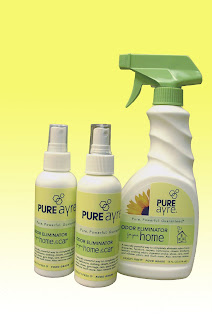
PureAyre Odor Eliminator

One of the little tricks I have for deciding what products to buy is to look at the warning label.

If the label screams CAUTION! or DANGER!, I think twice about putting the can or bottle in my pantry or bathroom. 

So even though I find it ... helpful to keep a scented spray in the bathroom, I'm not fond of the bilingual (Spanish and English) caution warning on the back of the bottle. Most of these scent sprays are pressurized, which explains the bulk of the warning (keep away from fire, flame or pilot light, container may burst at temperatures over 120 degrees Fahrenheit, do not puncture or incinerate, etc.) There are also bold warnings to keep the product out of reach of children and pets, and an additional warning that deliberately concentrating and inhaling the contents can be fatal.

Phew. 

In contrast, the unpressurized spray bottle of PureAyre Odor Eliminator label is much friendlier, sporting the big bold letters "COMPLETELY SAFE AND 100% READILY BIODEGRADABLE".

Now that's what we like to hear! 

Where our old scented spray didn't even bother to provide us with an ingredient list, PureAyre explains that it's made of just distilled water, food grade enzyme technology, natural mint and food grade preservative.

So how does it work and what's this about 'food grade' ingredients?

First the 'food grade' part. According to PureAyre, the enzymes and preservatives it uses are not only non-toxic, but actually edible. That's right, if you're cooking up an odiferous dish of liver with garlic and onions, you can actually spray PureAyre around the kitchen without worrying about risks from ingesting any droplets that settle on the food. 

(PureAyre does include what it calls "Common Sense Precautions" on the label, noting that PureAyre is not meant for internal use! It also says that in case of direct eye contact, you should rinse your eye with cool water if necessary. But frankly that's probably good advice if you got anything sprayed in your eye!)

So back to the original question - how the heck does PureAyre eliminate odors anyway? PureAyre says that the naturally occuring plant-based enzymes in its spray actually break apart odor molecules to clean the air and permanently eliminate odors.

Want more information? Wikipedia has a nice page on Enzymes and wikiHow talks more about enzyme-based odor removal. 

Note that if the odor source comes from a stain or spill on a carpet, rug or sofa, you'll need to find a way to penetrate to the source of the odor to completely eliminate the smell. PureAyre has a booklet (available online in English and French) that explains useful techniques on deoderizing carpets, fabrics, furniture, floors. There's even specific advice on eliminating skunk spray from pets or eliminating odors onboard boats and RVs. 

Does it work? You betcha. In our testing, we found that PureAyre performs better and more quickly than the old scented spray. It really does seem to eliminate the unpleasant odors rather than just masking them or covering them up. And we really like the minty smell that PureAyre leaves in its wake. (We think it was smart of PureAyre to add the minty scent since most everyone is a fan of mint. But perhaps there should be a completely unscented version too for people who prefer no smells at all?)

Personally, I'm looking forward to taking a small spray bottle of PureAyre with me to Europe this fall. If I find myself in any smoky hotel rooms - or perhaps even smoky restaurants - I can take out my PureAyre and start spraying! 

Where to buy:
You can buy PureAyre online ($19.99 for 22-ounce bottle to $175 for a kit that includes a portable electric fogger).

Offline, find PureAyre at PetCo Stores (nationwide, $7.19-$10.39 on sale) and at Whole Foods (West Coast only).

Monday, September 15, 2008

PlantLove from CARGO Cosmetics


If you love plants, then it's a good bet you'll be fond of the new line of PlantLove™ cosmetics from CARGO. 

According to CARGO, the new PlantLove Cosmetics Collection is 100% natural and wholly organic. 

CARGO says that PlantLove carries an ECOCERT™ designation that ensures product, process and packaging meets the strictest standards for natural, organic and environmentally friendly content.

Not only  are the PlantLove cosmetics themselves free of parabens, phalates, petro-chemicals and synthetics, but even the packaging is Earth-friendly. CARGO says that the compostable PlantLove cases are made from corn, while the biodegradable boxes are made from 100% post-consumer packaging. 

(In fact, the PlantLove lipstick samples we received actually had boxes embedded with wildflower seeds. You can moisten and plant the boxes to grow your very own wildflower patch!)

Our tester praised the colorful, cheerful flower pattern on the lipstick tube, particularly admiring the pink version designed by Lindsay Lohan. (All the colors have their own celebrity designers, from Courteney Cox to Mariska Hargitay.)

CARGO also says that PlantLove products are only manufactured in countries with solid environmental and labor records. (Our lipstick samples came from Canada, which certainly seems to have a solid reputation in both areas.) 

Furthermore, CARGO claims that even the mill supplying packaging materials for the brand manufactures under carbon neutral conditions using 100% renewable energy.  

And (yes there's more), CARGO also says that $2 from the purchase of every lipstick will be donated to St. Jude Children's Research Hospital™. 

Beyond lipstick ($20), the PlantLove Cosmetics Collection includes Loose Powder Foundation ($30), Pressed Powder ($30), Baked Illuminator ($28), Baked Bronzer ($28), Blush ($28), Lip Gloss ($20), Lip Liner ($16), Lip Balm ($20), Eye Shadow ($20) and Eye Liner ($16). 

Where to buy:
The PlantLove Cosmetics Collection debuts today at Sephora.com and in Sephora stores nationwide. 

Wednesday, September 10, 2008

Moen Water-Saving Faucets and Showerhead


I still remember Mrs. Symington, my high school biology teacher who had served in the Navy, telling us stories about 2-minute military showers where you were expected to get wet, turn off the water, soap up, then turn on the water to rinse. 

While I admired such water conservation, my own showers used to be quite profilgate (30-40 minutes). I'm pleased to say that I've cut that down to a more reasonable average 10-15 minute shower, but I still keep looking for ways to reduce my water use even further. 

That's why I was so pleased to find the Flow-Optimized Moen Water Saving Showerhead. This 1.75 gallons per minute (gpm) showerhead offers a 30% water savings over the industry-standard 2.5 gpm nozzle. Made in the USA, this simple but stylish showerhead can also lower your energy costs (by reducing your hot water usage). 

Available in Chrome, LifeShine® Brushed Nickel or Oil Rubbed Bronze, the Water Saving Showerhead can coordinate with many different Moen bath collections.


What sort of a showering experience does the Water Saving Showerhead deliver? Well, you won't get the tropical downpour feeling of a gigantic rain showerhead, but the Water Saving Showerhead's innovative spray formers concentrate the flow of water in a way that feels simultaneously gentle and soaking. Moen says that its designers have carefully arranged the streams of water to provide great full-body coverage, a claim that seems reasonable based on our personal testing. 

We also like clever design details, like the way that the showerhead has two flat places on its connecting nozzle that let you get a good grip with a wrench in order to fasten the showerhead tightly onto the water pipe.


If you're putting in new faucets, check out some of the WaterSense®-labeled lavatory faucets in the Fina™, Rothbury™ and Muirfield™ collections. The faucets use flow-optimized aerators that deliver water at a rate of 1.5 gpm (versus 2.2 gpm for traditional aerators).

Note that not all every faucet in a collection may have the flow-optimized aerators, so be sure to look for the WaterSense certification to  ensure you're getting a water-saving faucet.

Where to buy:

Use the "Where to Buy" link on Moen's website to  find a wholesaler that stocks the Flow-Optimized Water Saving Showerhead (MSRP $36 and up), the Fina faucets (MSRP $524 and up), the Rothbury faucets (MSRP $232 and up) and the Muirfield faucets (MSRP $78 and up). 

Moen also has a link on its site to online retailers that carry its products. It can be a little difficult to find certain products on these e-tailer sites, but we were able to find the Rothbury WaterSense faucets on Faucet.com, for example.