Wednesday, November 25, 2009

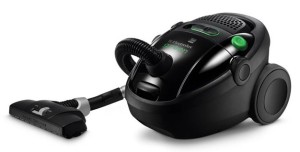
Electrolux UltraSilencer Green


Electrolux UltraSilencer Green canister vacuum cleaner
In August 2008, I reviewed an energy-efficient Eureka vacuum cleaner called the envirovac.

At the time, I gave the envirovac a thumbs up for performance, design and value. The bagless washable canister and filter meant that the vacuum wouldn't have any obvious recurring costs beyond its ultra-reasonable $72.22 price (via Wal-Mart).

But not everyone likes an upright vacuum. You can be an upstanding citizen (or even a member of the Upright Citizens Brigade) and still prefer a canister vacuum for example. (Here's a webpage by one canister-lover.)

So I was happy to have the chance to test the new Electrolux UltraSilencer Green canister vacuum that debuted in the US just a couple of months ago.

Although it sounds like some sort of weapon that 007 would use to dispatch his enemies in secret, the UltraSilencer Green is actually just a really quiet vacuum (maximum 71 decibels). If other vacuums sound like garbage trucks, the UltraSilencer Green is like a well-tuned Mazda Miata.

Electrolux UltraSilencer Green canister vacuum cleaner
The UltraSilencer is not only compact and nicely designed, it's also lightweight and easy to transport around the house. The Electrolux website says the vac tips the scales at approximately 12 lbs. For comparison, Wal-Mart lists the shipping weight of the envirovac as nearly 20 lbs., though the comparison is obviously not apples-to-apples since packaging can certainly add to the shipping weight.

And while Eureka had packaged the envirovac in a recycled box, Electrolux goes one step further by reportedly using 55% recycled materials in the construction of the UltraSilencer Green, while making the vacuum itself 90% recyclable. I love the cradle-to-cradle design philosophy at work here, and Electrolux says that using the recycled materials in building the UltraSilencer Green saves 2 liters of crude oil and 80 liters of water per vacuum cleaner. ((Note that there are various UltraSilencers made by Electrolux. I presume that only the Green one has the recycled/recyclable characteristics.)

From a performance standpoint, I have to admit that I probably like the feel of upright vacuums a bit better, but I did appreciate the light weight and flexibility of the UltraSilencer Green's long hose. With enough use, I'd probably get used to manuevering the UltraSilencer Green around the apartment. Suction was certainly more than adequate enough to pick up small debris from hardwood floors and low-pile carpet. (In fact, the suction was strong enough to lift entire unsecured carpet tiles right into the air!)

Electrolux UltraSilencer Green canister vacuum cleaner
I only really have one major gripe about the UltraSilencer Green. Although the Electrolux UltraSilencer Green is advertised as being 1/3 greener than comparable vacuums (presumably canister vacs), its 1250-watt maximum power usage is still significantly higher than the 960-watt needs of the 2008 envirovac. Since I like to that that efficiency marches hand in hand with progress into the future, it would have been nice if the UltraSilencer Green had used fewer than 960 watts, but perhaps canister vacs just have higher power needs (and better suction?) than upright vacs...


Where to buy:

You can buy the Electrolux UltraSilencer Green online through Bed Bath & Beyond for $299.

Disclosure - Electrolux lent me an UltraSilencer Green vacuum to review.

Wednesday, November 11, 2009

Ivee Bamboo Clothing

Sydney Bamboo Terry Pants in Grey available at IveeStyle.com


Why do I like bamboo?

According to multiple sources (1,2,3), bamboo is -
  • Ultrarenewable, one of the fastest-growing plants in the world
  • Good at preventing soil erosion
  • Easily dyed, with minimal water requirements
  • Very hardy, able to survive both drought and flood conditions
  • Able to grow with little water
  • 100% biodegradable
  • Naturally antibacterial

But while much bamboo clothing may be eco-friendly, it's not automatically stylish.

Fortunately, Ivee clothing has used those soft, comfy, body-flattering bamboo threads in its hip, sexy yoga designs to create some mighty appealing pants, tunics, tees and hoodies.

One word of advice for shoppers - these clothes really do hug your curves!

My wife didn't mind the snugness on her pair of Sydney Bamboo Pants ($110). In fact, she found them so comfortable that they moved into regular rotation as one of her favorite pants to wear for lounging around the house. She reported that quality was top-notch and the pants made it through a couple of washes in our industrial-strength apartment building washers and dryers looking good as new.

Kayla bamboo/cotton/spandex tunic available at IveeStyle.com

Meanwhile, I didn't get a chance to check out the Kayla Tunic ($110) or Trinity Terry Hoodie ($112) in person, but the photos look like they'll give anyone some sweet Matrix / Blade Runner ultramodern style.

Our only qualms - The price tags might make it hard to build an entire Ivee wardrobe. I understand that high-priced items sometimes seem intrinsically more desirable, but couldn't Ivee have made its separates a little more affordable, particularly given the fact that they're made in China (a country not exactly known for its exorbitant labor costs).

Where to Buy:

You can order items from Ivee's bamboo clothing line directly through the IveeStyle.com website.

Offline, you can find Ivee clothes at selected retailers including the Sports Club LA (Boston, NYC, San Francisco), Salon Magrit (Palm Beach, FL), O2 Aspen, Dailey Method (West Coast) and Pacific Athletic Club (San Francisco and San Diego).

Disclosure - Ivee gave me a pair of pants to review.

Wednesday, November 4, 2009

Smart fortwo Passion Cabriolet

smart fortwo cabriolet

Lowering the top on the smart fortwo cabriolet is a breeze


Parking a smart fortwo should be at the top of the list of Easiest Things in the World.

Even if the parking space is lilliputian, even if you have approached it from an odd angle, even if the cars on either side of you are gargantuan trucks, you should be able to squeeze into the space with room to spare.

I must confess that I was a little nervous to test driving the smart fortwo. Yes, I requested a loan of the car. After years of decrying the practice of individual people commuting in massive trucks, I decided it was time to squeeze myself into what is surely the tiniest car on the market today.

The two-passenger smart car's dimensions tell the story. Its total length is less than 9 feet - more than 3 feet shorter than the already compact Mini Cooper. The relative tinyness of the smart fortwo has an interesting effect on interactions with other drivers. You must drive defensively because some drivers will act as if they simply don't see you because it's impossible anything as small as a smart fortwo is actually on the road. On the other hand, there are also drivers who are also so charmed by the smart fortwo's cuteness that they will wave you along and give you some special deference, much as a tiger might refrain from chasing a canary.

Does the smart fortwo feel cramped inside? Not particularly. I stand over 6-feet tall and I had plenty of headroom, enough elbow room and just enough leg room.

Of course, you can't take long road trips in the smart fortwo - unless you put your luggage into a compacting machine first. If you want to see out the (small) rear window, don't count on holding more than your smallest suitcase and a couple of bags of groceries. That's all we managed to fit in the Smart's 7.8 cubic feet of cargo space (up to the belt line).

The smart fortwo coupe. Cute? You betcha.
How about the smart fortwo's design? Cute as a button - and about the same size! :) People will stare. They may start conversations or ask to trade the smart fortwo for whatever gas-guzzler they're driving. Almost every time I parked the smart fortwo, I turned to marvel at how compact and fun it looked next to whatever staid minivan or sedan was parked next to it.

I thought the fit and finish of the inside components was generally pretty good. I liked the bold red accents on the dashboard and control panels.

I was also very impressed with the performance of the Cabriolet roof that opened and closed at the push of a button by sliding along a track at the top of the vehicle.

On the other hand, I would have exchanged the Passion Cabriolet's complicated audio system in a heartbeat for an interval windshield wiper system or cruise control.

So from a looks, design and fit standpoint, I was pretty pleased with the smart fortwo. Then I started driving it.

I had been a little trepidatious based on my advance read of several blogs including Edmunds and The Truth About Cars that excoriated the smart fortwo's transmission, acceleration and handling.

Basically, I wholeheartedly endorse their conclusions. I drove the Smart in urban traffic (Brooklyn, Manhattan), suburban (Long Island) and rural (Hudson Valley). If your commute involves very smooth, straight roads at moderate speeds of 40-50 mph, the smart fortwo could be a good car for you. But if your route involves winding roads, hills, highways where good acceleration is a must or the traffic flows around 70 mph, I would say that the smart fortwo could very well make for a scary ride.

I'm not refering to its size or safety characteristics. Smart has created a great website (SafeandSmart.com) with compelling personal anecdotes about the strength of the car's "safety cell" structure. I fully sort of believe that the safety cage would protect me in a crash, but I'd prefer to avoid getting in a crash in the first place and I had several occasions (off ramps, on ramps, hard turns, occasions that called for acceleration) where I felt that I was lucky to avoid collisions with other vehicles or the landscape in my smart fortwo.

And then there's the small matter of bumps in the road. Both my passenger and I actually had back pain after driving for several hours in the smart fortwo down admittedly very potholed and uneven highways in the NYC metro area. Yes, I blame the highways, but I've ridden electric bicycles that offered a smoother ride at 20 mph on New York's streets.

I could go on to talk about how the 'automated manual transmission' drove me crazy in both full automatic and semi-manual modes. Or about how the vibration and engine noise are exhausting even at low speeds, but you probably get the picture.

It's all a shame since the smart fortwo really is an attractive car from an eco-friendly standpoint. In mostly highway driving, I managed to get around 40 mpg, which is very impressive for a non-hybrid car.

Not only that, but the smart production process is pretty eco-friendly too, including the use of prefabricated modules at the French factory where smarts are produced, plus water-soluble paints, recyclable body panels and a power-coating of the safety cell that eliminates the need for solvents.

Heck, the car even has 'flax-based components' in its dashboard! How cool is that!

The car itself is classified as an Ultra-Low Emission Vehicle (ULEV). Smart's press materials trumpet the clever design of an electric pump that "blows fresh air into the exhaust port when the engine is cold to almost completely oxidize the carbon monoxide (CO) and hydrocarbons (HC) and render them harmless." Sounds good to me.

Truth be told, I would have a hard time recommending the current generation of the smart fortwo. As this blog attests, I'm pretty passionate about protecting the environment, but I also have minimum comfort and handling thresholds when it comes to assessing a car and smart fortwo didn't meet them.

On the other hand, I'm still excited about the news that smart is planning an electric version of the fortwo, expected to arrive in the US (via pilot programs) in late 2010. With any luck, the electric car will have better and smoother acceleration. If so - and if smart can improve handling and shock absorption - the electric smart car could be a very smart choice indeed.

Where to buy -

Purchase a smart fortwo at a Dealer near you.

The smart fortwo Passion Cabriolet starts at $16,990, but a few options (like power steering) and destination charge brought the model I tested up to just $17,980.

According to the smart website, there is a base Pure Coupe that lists for under $12,000, but expect to pay extra for options such as air conditioning and radio.

Disclosure - Smart USA lent me a smart fortwo Passion Cabriolet to review.

Friday, October 16, 2009

E+ Electric Bikes - Elite Mountain Bike

In addition to consumer e-bikes, Electric Motion Systems also makes a Tactical Bike for police departments (photo via Electric Motion Systems website)

The powerful, rugged E+ Elite Mountain Bike (photo via Electric Motion Systems website)

Like a little raw speed with your electric bike?

I clocked my tester E+ Elite Mountain Bike from Electric Motion Systems at around 25 miles per hour on a flat straightaway with no pedaling.

The Elite version of the E+ bikes (designed for 'off road use only') comes with a 1000 watt in-wheel motor, but you can get 750 watt motor versions of the E+ bike in Cruiser or Mountain Bike styles that don't have the 'off-road only' stipulation.

The power of the in-wheel NiMH battery and motor system is definitely one of the major selling points for an E+ bike. Mounting the battery and motor low on the bike is also supposed to help keep the bike stable by creating a low center of gravity. The logic is flawless, but in practice it didn't make the bike feel appreciably more stable than any other e-bike that I've ridden.

So here's what I liked about the E+ Elite bike that I tested -

The in-wheel battery and motor design gives E+ bikes a distinctive silhouette (photo via Electric Motion Systems website)

1. Speed and Power - Press down on the throttle lever and the bike takes off. It's like a stealth moped.

2. Rugged design - The bike felt fully capable of handling some light off-road action. The bike's manual indicates that the E+ Elite Mountain Bike can handle paved roads, gravel surfaces and even rough trails with small obstacles, but it does emphasize that the bike should not be used in a jumping scenario. Although it would have been nice if the E+ Mountain Bike came with some splash/mud guards - especially since the bike is designed to allow light off-road use where there's usually a lot of dirt, mud, gravel and other earthy stuff.

3. Made in the U.S.A. - Electric Motion Systems is based in Virginia, and that's where it makes its E+ bikes. I like the idea of supporting domestic production, both in the interests of reducing environmental shipping costs and supporting American workers (particularly in a recession).

4. Style - The E+ Elite Mountain Bike got admiring looks and comments from bike messengers, European tourists and others. It's not flashy, but it will get noticed.

5. Cruise Control - I don't think I've seen this feature on any other e-bike. Press a button on the E+QUE Display/Controller unit on the handlebar and the bike will attempt to maintain a set speed. It's pretty nifty.

6. Regenerative Mode - Like the OHM bike, the E+ bikes can be set into regenerative mode to recharge the battery while going down a hill (or perhaps when the bike is mounted into a stationary rack). Unfortunately, it seemed harder to use the E+ regenerative system than the OHM system. Even on a downhill slope, I had a hard time pedaling the E+ bike in regenerative mode.

Now here are the things that irked me about the E+ Elite Mountain Bike:

1. Price - Even though I didn't pay to test the bike thanks to the generosity of Electric Motion Systems and Scott Gibson of EcoPioneer, I can't test a product without considering its price (and therefore its value). After all, Tesla Motors may make a beautiful electric sports car, but the price puts it out of reach for most consumers.

The E+ Elite Mountain Bike carries a MSRP of approximately $4,000. For perspective, consider that a new Vespa LX50 scooter for MSRP $3,299. True, the Vespa uses gasoline and is therefore less eco friendly, but it does get 95-100 mpg and goes 39 mph (according to the Vespa site).

I'm just saying that I think it will be hard for most people who aren't rolling in dough to spend $4,000 on an electric bike when they could get a gas scooter for hundreds of dollars less (actually thousands of dollars less if they are willing to get a Yamah C3 or Honda Ruckus scooter).

Now Electric Motion Systems is running a limited time offer to give customers a free Elite upgrade plus a rebate. These deals bring the price of the bike down to a more palatable $3,095 with free shipping.

That's better, but it's still a lot of dough and a few hundred dollars more than some other e-bikes we tested like the OHM Urban XU500 or the A2B Electric Two Wheeler (both of which retail for around $2800).

Push-Lever Throttle - The E+ Elite Mountain Bike uses a push-lever thumb throttle on the right handlebar. When you want the motor to kick in, you have to push down on the throttle. It sounds simple enough, but in practice I much preferred the twist throttle used on the A2B bike. As one of my commenters pointed out on the A2B review, it's actually quite safe to have a throttle that needs to be twisted toward you in order to generate power because it makes it much harder to accidentally gun the motor when reaching for the brake. But with a push-lever thumb throttle, I did just that and nearly accelerated into trouble a couple of times when I was trying to execute a sudden braking maneuver.

Weight - Like the A2B, the E+ Elite Mountain Bike tipped the scales around 70 lbs. Since mountain bikes already have more resistance than road bikes due to their thick tires, I found it nearly impossible to pedal the E+ Elite Mountain Bike without constantly using at least a little bit of battery power. I would urge Electric Motion Systems to prioritize weight reduction in their R&D effort, since a 10 or 20 pound lighter bike (like the OHM XU500 or the iZip Via Rapido) is much easier to pedal with pure human power - extending the range and providing the possibility of some exercise. (The combination of mountain bike seating and the need to constantly push the throttle with my thumb ended up putting a lot of pressure on the outside fingers of my right hand. In fact, after one long ride, my little finger and ring finger on the right hand were partially numb and tingly for hours. Not a good feeling.)


Maybe you would prefer your E+ electric bike in a Beach Cruiser style? (photo via Electric Motion Systems website)

Range - Electric Motion Systems says that the E+ Elite Mountain Bike should be able to go 25-28 miles on a full battery at 15 mph with a 185 lb. rider on flat ground and no pedaling. I weigh a good 25 lbs less than that theoretical rider and managed only around 15 miles of range with occasional pedaling on mostly flat terrain. For some of this time, I was experimenting with the Cruise Control feature of the bike (which I later found out might reduce range according to some online forums), but I still have to say that I was disappointed that the battery didn't last a longer distance.

Recharging Process - Not only did the recharging process take many hours, but the process of connecting the charger to the bike itself is a bit cumbersome. (In fact, I ever cut my hand a little bit trying to disconnect some wires in order to get access to the charging plug the first time I tried to recharge the bike. After that, I wore gloves when taking the charger on and off the bike.

Also, because the battery is built into the wheel, it's impossible to take the battery off the bike for recharging without removing the whole front wheel. In my opinion, that's a significant drawback to the E+ design. One of the nice things about the designs of many e-bikes - even much less expensive bikes like the iZip Via Rapido - is that it's easy to park the bike at a rack and remove the battery to take it into an apartment or office for charging. To be fair, taking the wheel off the E+ Elite Mountain Bike isn't that hard, but it is a heavier, more time-consuming, dirtier process than just sliding a battery pack out of the bike and literally putting it into a shoulder bag or bookbag.

Bottom Line - If you have deep pockets and are looking for a fast, rugged, made-in-the USA electric bike that can deliver some serious off-road fun, the E+ Elite Mountain Bike could be just the ticket. For urban commuters, I think there are some less expensive and more versatile options like the A2B (for twist-throttle fans) or the iZip Via Rapido (for those who prefer pedal-assist).

Where to Buy:

The Ellsworth Commute Ride, just one of the sweet custom designs offered by E+ (photo via Electric Motion Systems website)

You can order an E+ Elite Mountain Bike - or any of the other electric bikes that Electric Motion Systems makes - directly through the company's website.

Be sure to check out the sweet array of custom designed e-bikes that E+ can build on request.

Since every e-bike feels different, I'd highly encourage you to test ride an E+ bike at a local dealer in the U.S. or Canada before making a purchase decision.

Be sure to ride safely, wear a helmet and check the local regulations covering the use of e-bikes in your community.

Disclosure - E+ loaned me an Elite Mountain Bike to test and review for approximately one week. I returned the bike to an E+ representative at the end of the test period.

Wednesday, October 7, 2009

CleanWell hand sanitizer

CleanWell with Ingenium(TM) hand sanitizer

I'm somewhat of a germaphobe.

(I used to be an extreme germaphobe, but I'm in recovery. To anyone who has trouble relating, just try riding the NYC subway for a while and see if you don't start washing your hands compulsively.)

I guess the technical name for this fear-of-germs is mysophobia. I think the fear has been pretty well ingrained and promoted by sensationalist media programming hyping pandemic fears, which explains why millions of Americans lather themselves in 'antibacterial' soaps containing triclosan, despite some concerns about bacterial resistance and health effects on humans and other creatures (like frogs).

When it comes to hand sanitizers, of course, the most prominent ingredient is usually alcohol. Johnson & Johnson, for example, has achieved tremendous success with its Purell sanitizer, which relies on 65 ethyl alcohol for its germ-killing power. The advertising on Purrell bottles claims the product will kill 99.99% of germs.

Aside #1 - According to HowStuffWorks, ethyl alcohol is the same alcohol found in alcoholic beverages, so theoretically you could carry around a pint of vodka to use as a hand sanitizer, although it would probably be a more pricey solution -- unless you know where to get really cheap vodka.

Aside #2 - I have heard contradictory information over the years about whether hand washing or alcohol gels do a better job of sanitizing the hands. Internet research failed to clear up the issue to my satisfaction -- although it did reveal a disturbing report from USA Today that use of alcohol gel in one Nebraska hospital failed to lower infection rates.

The estimable Mayo Clinic says that antibacterial soaps are no more effective at killing germs than regular soap. It also says that alcohol gels do a better job at slaughtering bacteria than soap and water, but it still recommends washing if your hands are visibly dirty.

All of which brings us (at last!) to the review of today's product - CleanWell natural sanitizers.

One of the main selling points of CleanWell is that they are alcohol-free, but still claim to kill 99.99% of all germs thanks to an ingredient called Ingenium(TM), which as near as I can tell from CleanWell's website is made up of essential plant oils, primarily thyme.

Now lots of people might be interested in having an alcohol-free sanitizer. Despite Purell's marketing claims, I know from personal experience with alcohol-based sanitizers that they do sometimes leave my hands feeling a bit dry and irritated. The question is whether thyme (and other essential oils) kill germs as well as alcohol does.

I found one abstract of an article online (from Applied Microbiology) that purports to show that thyme does in fact do a good job of killing E. Coli bacteria.

More important, CleanWell points to results from ATS Labs in Egan, MN to support its claims for the germ-killing power of Ingenium. According to the results in the CleanWell press kits, the lab tests showed that Ingenium killed 99.99% of various nasty germs (staph, pneumonia, etc.) in 15 seconds.

The safety aspect of CleanWell is certainly appealing. CleanWell's press materials state that the product has the EPA's lowest possible toxicity rating and therefore does not have to carry any warning labels. In fact, it is marketed as 'safe for kids'.

CleanWell with Ingenium(TM) hand sanitizer

CleanWell's sanitizer is available both in wipe and spray format. The wipes are labeled as being cruelty-free. It's not clear if they are biodegradable, however.

The pocket-size sample spray that CleanWell sent over has a nifty design, although it's not clear if the plastic bottle is recyclable. (It's not labeled with any recycling number.) Also I wasn't sure if one pump of the mist/spray was enough to kill germs on my hands or if I should pump once for each hand? It might be nice if CleanWell could add some instructions to the label.

If you do have sensitive hands, CleanWell could be a great sanitizing option since the wipes didn't dry out my hands at all. In fact, they're pretty much saturated with moisturizing liquid. If anything, CleanWell could reduce the moisture a bit and still have a very nice wipe product -- although perhaps the wipes really need to be saturated with Ingenium to work properly...

Finally, the scent is really nice. Plenty of wipes have a harsh chemical or highly perfumed scent that can be embarassing, even nauseating to use -- especially if you're wiping or gelling right before/after eating. The light herbal scent of CleanWell is subtle, pleasant and generally inoffensive.

In conclusion, CleanWell looks like a nice hand sanitizer option. As a non-scientist, it's hard for me to say for sure whether it's really safer or cleaner than an alcohol-based gel/wipe, but I'm inclined to say that it appears a bit safer and greener. I would love to see the company move toward biodegradable wipes and recyclable/recycled bottles if it truly wants to embrace an eco-friendly identity.

FYI, The Daily Green published an interesting article last year on the whole hand sanitizer gel craze. I think The Daily Green may be overstating risks of triclosan (and I believe there plenty of alcohol gels on the market that don't contain triclosan), but triclosan's prevalence in human waste streams is disturbing.

On the other hand, The Daily Green wasn't a huge fan of CleanWell either partly because of a lack of information around inactive ingredients. Well the spray bottle I received did have an ingredient list including aloe leaf juice, citric acid, orange oil, oats, litsea oil, oregano oil and water -- all of which seem relatively innocuous to me from a human health standpoint. It does also contain Copper PCA and dicapryl sodium sulfosuccinate, both listed as low hazard ingredients by the Enivronmental Working Group, and sodium citrate, which apparently is safe enough to be an ingredient in ice cream! :)

Overall, I think CleanWell deserves strong consideration by eco-friendly shoppers looking for some portable protection from germs.

Where to buy:

Purchase online from CleanWell (8 pack of 10-wipe packets for $21.99, 6 pack of 1-ounce spray bottle with 225+ sprays for $16.99). Incidentally, these prices are much lower than the cost of other hand sanitizers I've seen marketed as eco-friendly.

You can also use the CleanWell store finder to locate a retailer near you that carries the product.

Disclosure - CleanWell provided me with complimentary samples of its hand sanitizing products to test while writing this review.